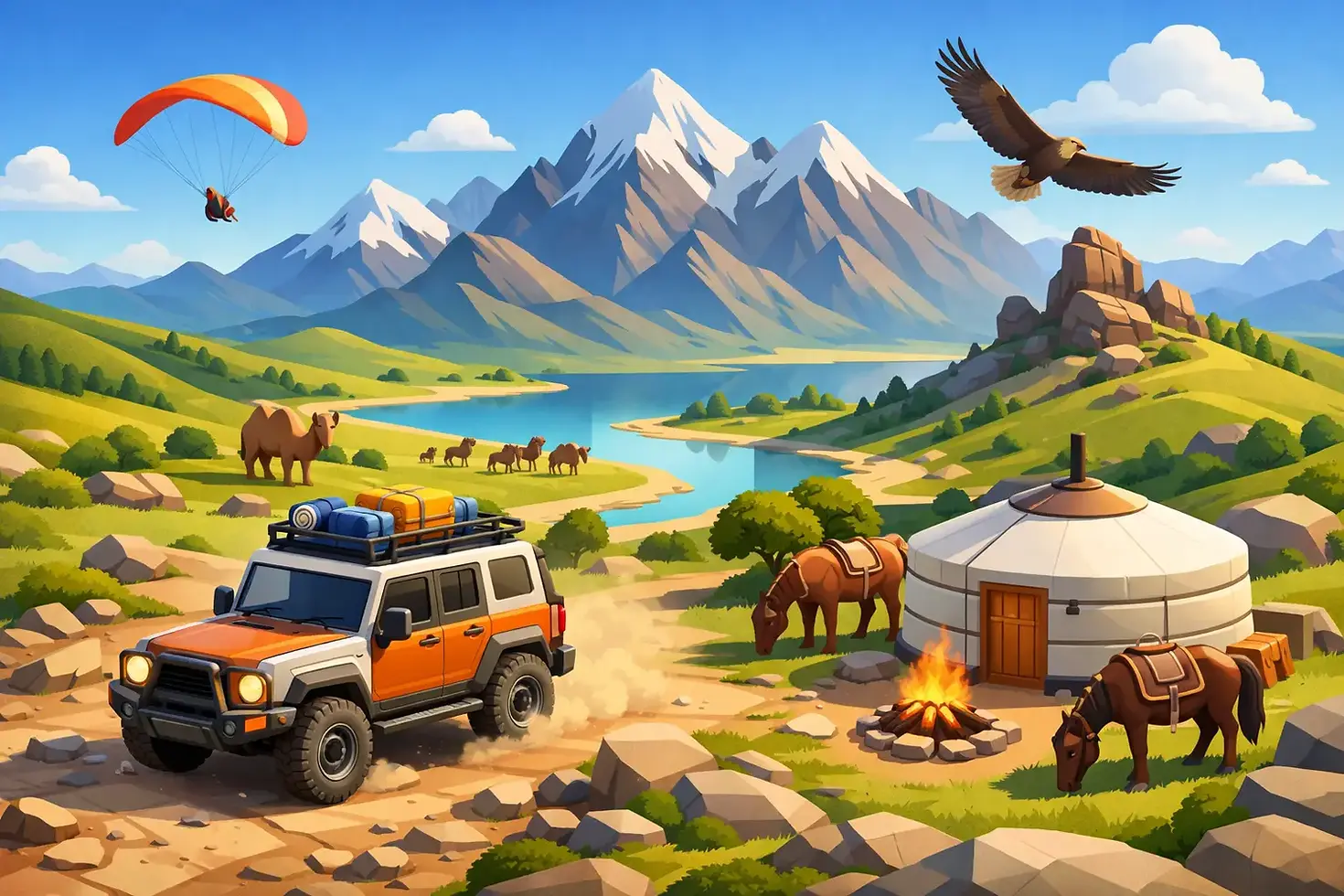
Off Road Mongolia for Real Adventure
- David Luis Guiterrez Serrano
- Jun 10
- 6 min read

The map stops being useful pretty quickly in off road Mongolia. Pavement thins out, marked routes fade, and the country opens into a scale that changes how you ride, camp, and think. That is the draw. You are not threading from attraction to attraction. You are crossing a living frontier of steppe, desert, mountain passes, river valleys, and empty horizons where the route often matters more than the destination.
For riders and expedition travelers, Mongolia delivers something that is getting harder to find anywhere else - real overland freedom. Not the curated version. The actual kind, where weather can reset your day, fuel planning matters, river crossings are not theoretical, and a distant line across the grasslands can become your road for the next two hours. If that sounds like work, Mongolia may not be your trip. If that sounds like exactly why you travel, keep reading.
Why off road Mongolia feels different
A lot of destinations market themselves as wild. Mongolia barely has to try. The country is vast, lightly populated, and still defined by movement, land, and weather more than infrastructure. That changes the entire travel experience.
You do not ride here to tick off landmarks every 40 miles. You ride for immersion. One day can take you from wide open steppe into rocky mountain terrain, then down into a valley where herders are moving livestock under a sky that seems too big to be real. The terrain keeps shifting, and so does the pace. Fast gravel can turn into sand. A visible track can split into six lines and then disappear altogether.
That unpredictability is the point. Mongolia rewards travelers who want terrain with personality, not polished access. It is one of the few places where an off-road route still feels like an expedition rather than a recreational loop.
Who Mongolia is really for
Off-road Mongolia is not only for elite riders or hard-core survivalists. But it is best suited to people who want an active role in their travel. If you prefer tight plans, hotel check-ins, and guaranteed comforts every night, Mongolia can feel rough around the edges.
For motorcycle travelers, the country is especially compelling because the landscape invites range and improvisation. Long-distance riding makes sense here. So does changing course when the land suggests a better line. Experienced riders tend to appreciate the technical variety, but even strong intermediate riders can thrive if the route, support, and bike choice match their ability.
That last part matters. Mongolia is not difficult in the same way all day, every day. Some sections are open and forgiving. Others demand attention, stamina, and smart judgment. The right setup can turn a challenging trip into an unforgettable one. The wrong setup can turn it into damage control.
What the terrain actually looks like
People often imagine Mongolia as one continuous grassland. The reality is much better. The country gives you a broad mix of surfaces and regions, and each one changes the riding experience.
The central steppe is where many travelers first understand Mongolia's scale. Tracks stretch across open grassland with almost no visual clutter, and the sense of freedom is immediate. You can cover ground efficiently here, but wind, weather, and navigation still keep things honest.
Move west or north and the ride becomes more textured. Mountain regions bring rougher tracks, elevation, forest sections, and more technical riding. River crossings are part of the picture, especially after rain. In the south, the Gobi shifts the mood completely. The terrain opens again, but this time with harder desert lines, sandier sections, rock, and dramatic emptiness.
The beauty of Mongolia is not that one region is best. It is that each region asks something different from the traveler. A good route is not just scenic. It balances speed, remoteness, challenge, and recovery so the trip keeps building rather than grinding you down.
Guided expedition or independent ride?
This is where many travelers need to be honest with themselves. There is no prestige in choosing the harder logistics if those logistics eat the trip.
A guided expedition makes sense if you want to push deeper with less friction. That usually means better route design, local knowledge, recovery support, stronger camp flow, and a pace built around the terrain rather than guesswork. It is also the better option if your priority is maximizing ride quality instead of spending mental energy on every fuel stop, weather call, and navigation decision.
An independent rental-based ride can be incredible if you have the right experience and mindset. The freedom is real, and so is the responsibility. You need to think about fuel range, tools, luggage, weather shifts, backup routes, and what happens when the track you expected is no longer the track in front of you. For some riders, that is the whole appeal. For others, it is better handled with expert support behind the scenes.
There is no single right answer. It depends on your riding level, your appetite for uncertainty, and whether your idea of freedom includes managing risk in real time.
The challenge is part of the reward
Mongolia is not polished adventure travel. It is dusty, physical, exposed, and occasionally stubborn. That is exactly why it stays with people.
Fatigue plays a role here. So does weather. A clear morning can turn cold, wet, and slow by afternoon. Water crossings can be simple one day and more serious after rain. Mechanical issues are not constant, but they matter more when the nearest town is not around the next bend.
That does not mean the country is hostile. It means the experience is real. Every smart decision pays off. Packing light matters. Choosing the right bike matters. Knowing when to push and when to back off matters. Mongolia tends to reward travelers who respect the land instead of trying to dominate it.
Planning off road Mongolia the smart way
The strongest Mongolia trips are built around rhythm. You need momentum, but you also need enough flexibility to adapt. Trying to overplan every mile usually backfires. At the same time, showing up with no framework at all is not bold - it is inefficient.
Season matters first. Summer offers the broadest access and the most dependable riding window, but conditions still vary by region. Early and late season can bring beautiful light and fewer travelers, though cold, mud, and route limitations become more relevant. Your ideal timing depends on whether you value reach, comfort, or a slightly sharper edge.
Route design comes next. Big mileage looks appealing on paper, but Mongolia is better when the route has breathing room. A strong itinerary mixes fast sections with technical ones, remote camps with occasional reset points, and enough margin for weather or exploration. The best trips do not feel rushed. They feel earned.
Bike choice is equally important. Too much machine can wear you out. Too little range can limit where you go. The right setup depends on the region, the route length, the support level, and your comfort off pavement. Riders planning with a Mongolia specialist usually avoid the most common mistakes here because the bike is matched to the country, not just the brochure.
Why specialists matter in a place like this
Mongolia is one of those destinations where local depth beats generic adventure branding every time. Anyone can say a route is remote. It takes real field knowledge to know which regions connect well, where conditions shift, what kind of rider a route actually suits, and how to build a trip that feels wild without becoming chaotic.
That is where a focused operator like Terra Firma Journeys stands apart. The value is not just access to bikes or a fixed itinerary. It is the ability to shape an expedition around what you want from Mongolia - more technical riding, deeper remoteness, a shorter high-impact route, or a broader overland journey with guided support.
For travelers serious about getting beyond the usual circuit, that kind of specialization is not a luxury. It is often the difference between a good trip and the ride you will still be talking about years later.
The real payoff
What makes off road Mongolia special is not only the scenery, though the scenery is immense. It is the feeling that the country still allows genuine movement. You can cover serious ground, sleep under huge skies, ride through landscapes that remain largely unprocessed by tourism, and end the day feeling like you took part in the terrain instead of simply observing it.
There are easier places to travel. There are more comfortable ones too. But if you are chasing a trip with space, consequence, and freedom at its core, Mongolia keeps rising to the top for a reason. Come ready to ride hard, adapt fast, and let the land set the terms. That is where the real adventure begins.


Comments